
How to Read the Orderbook: A Beginner’s Guide to Prediction Markets
There are a few things you need to know in order to read prediction markets like a pro.
There is no complicated jargon or finance degree required to get through this article; it’s just a simple breakdown of what you actually need to understand trading on both Kalshi and Polymarket.
PREDICTION MARKETS ARE NOT SPORTSBOOKS
This is the first, and maybe the most important, thing you need to understand.
At a sportsbook, you’re betting against the house, which sets the odds and takes a cut. If too many people bet on one side, the house adjusts the line to protect itself.
At a prediction market, you’re trading against other people, not the house or a company. The platform just matches buyers and sellers through what’s an “orderbook.”
If you think Democrats will win the Senate, you buy a “Yes” contract. If someone else thinks they won’t, they sell you that contract. The price that the two parties agree to transact at becomes the odds, or probability, at that point in time.
That’s the reason prediction markets tend to be more accurate than polls, pundits, or your uncle at Thanksgiving. The price reflects the wisdom of everyone with money on the line and tends to aggregate all available information into a single number.
CONTRACTS, NOT BETS
In a sportsbook, you place a bet. In a prediction market, you buy a contract.
Every contract works the same way:
- If the event happens, the contract pays out $1.00.
- If it doesn’t, the contract pays out $0.00.
- The current price tells you the market’s implied probability.
If a contract is trading at 51 cents, the market is saying there’s a 51% chance the event happens. If you buy at 51 cents and it resolves “Yes,” you make a 49-cent profit. If it resolves “No,” you lose your 51 cents.
Every market on both Kalshi and Polymarket works this way. The price is the probability, and the profit is the difference between $1.00 and what you paid for your contract.
HOW TO READ THE ORDERBOOK
Here’s where most beginners get lost. When you open a market, you don’t just see a single number. You see something like this:
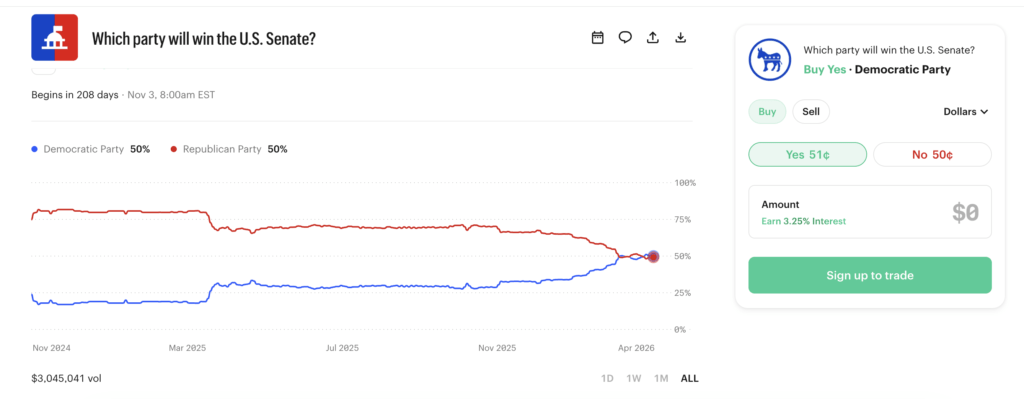
Source: Kalshi — “Which party will win the U.S. Senate?” Democratic Party at 51%.
Here is an example of a Kalshi orderbook. It looks complicated, but it’s actually simple once you know how to look at it.
The headline number (51%) is the last traded price. Someone just bought or sold a contract at 51 cents, implying the market thinks that’s the best probability.
Below that, the orderbook splits into two sides:
Asks (the red/sell side) are people willing to sell you a “Yes” contract. They’re listed from cheapest to most expensive, bottom to top:
- 51¢ — 11,423 contracts available at this price ($5,826 total)
- 52¢ — 156 contracts ($5,907)
- 53¢ — 18,196 contracts ($15,550)
- 54¢ — 21,000 contracts ($26,890)
If you want to buy right now, the cheapest available price is 51 cents. That’s called the “best ask.” You’d be buying from someone who thinks the probability is lower than 51% — they’re happy to sell you the upside.
Bids (the green/buy side) are people willing to buy a “Yes” contract from you. They’re listed from highest to lowest:
- 50¢ — 24,858 contracts ($12,430)
- 49¢ — 19,697 contracts ($22,080)
- 48¢ — 50 contracts ($22,100)
If you want to sell right now, the best price someone will pay you is 50 cents. That’s the “best bid.” These are people who think the probability is at least 50% — they want in, but only at the price that they think is fair.
The gap between the best bid (50¢) and the best ask (51¢) is called the “spread.” In this case, it’s 1 cent. That’s very tight, which means buyers and sellers mostly agree on the price. A wider spread (say, 45¢ bid / 55¢ ask) means there’s more disagreement and uncertainty on what the correct odds should be.
WHAT THE DEPTH TELLS YOU
The numbers next to each price (the “contracts” column) tell you how much money is stacked at that level. This is called “depth,” and it matters.
Look at the bid side of the Senate market:
- 24,858 contracts at 50¢ — that’s a pretty heavy wall, over $12,000 worth of buyers who think 50 cents is fair value. If the price starts dropping, it has to chew through that wall before it can fall further.
- 19,697 contracts at 49¢ — another big wall right behind it.
Now look at the ask side:
- 11,423 contracts at 51¢ — thinner than the bid side.
- 18,196 contracts at 53¢ — a bigger wall, but two cents higher.
What does this tell you? There’s more buying interest (depth) below the current price than selling interest above it. This is a slightly bullish picture; traders are more eager to buy on a dip than sellers are to dump into a rally.
This isn’t a guarantee of direction, but when you’re staring at an orderbook and wondering “which way is this going?”, the depth gives you a clue.
THE FOUR THINGS TO CHECK BEFORE YOU TRADE
If you’re thinking about actually putting money into a prediction market, here’s the orderbook checklist:
1. Volume. How much total money has been traded in this market? The Senate control market in the picture above has millions in volume, but a random House race might have only $2,000. Higher volume means more reliable pricing and easier entry/exit.
2. Spread. What’s the gap between the best bid and best ask? A 1-cent spread is great. A 10-cent spread means you’re essentially paying a toll or fee just to get in. Tight spreads = liquid market. Wide spreads = be careful, especially with market orders.
3. Depth. Are there real orders stacked behind the best bid and ask? If the best bid is 50¢ but there are only 10 contracts there, one moderately sized sell order could crash the price to 45¢. Thin depth means very volatile prices.
4. Resolution rules. This is the one people skip and then regret. Every market has specific rules for how it resolves. “Will the Senate flip?” might resolve based on who controls the chamber on January 3, 2027 — not election night. Read the rules tab before you trade. Always.
WHY THIS MATTERS EVEN IF YOU NEVER TRADE
You don’t need to put a dollar into Kalshi or Polymarket for this to be useful. The orderbook tells you something no poll, pundit, or news article can: what people with money at risk actually believe.
When we say “Democrats at 51% to win the Senate,” that’s not a poll of 1,000 likely voters. It’s thousands of traders putting real money behind their conviction. The orderbook shows you exactly how much money is on each side and at what price.