
Kalshi Launches Art Markets: Fine Art Auction Predictions

Kalshi Art Markets are now live, bringing prediction trading into the world of fine art auctions.
As Edgar Degas once said, “Art is not what you see, but what you make others see.” Today, that idea feels increasingly challenged, as markets shift focus from what art expresses to what it can earn — turning masterpieces into measurable, tradable outcomes.
Kalshi, a CFTC-regulated prediction market platform in the United States, has expanded into the fine art world with the launch of its new “Art Markets” category. This move introduces a new way for traders, collectors, and investors to engage with high-value art auctions using regulated financial instruments.
The new offering allows users to trade event contracts tied to real-world outcomes at major auction houses like Sotheby’s, Christie’s, and Phillips. These contracts are based on publicly reported auction results, bringing more transparency and accessibility to a market that has traditionally been difficult to enter.
What Are Kalshi Art Markets?
Kalshi’s Art Markets are prediction-based contracts that let users speculate on specific outcomes in upcoming art auctions. These contracts are typically structured as binary (yes/no) or range-based questions with clear, verifiable outcomes.
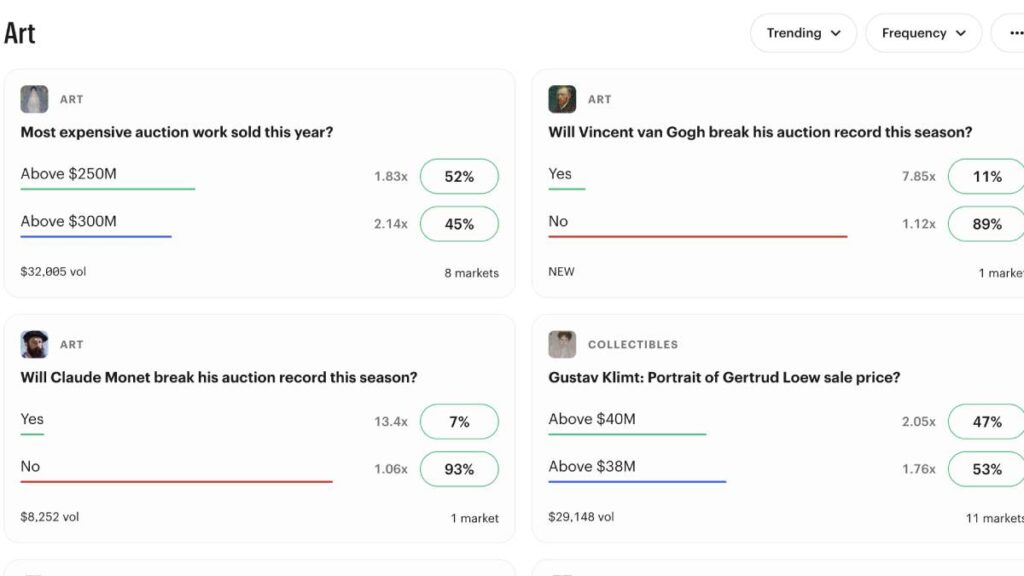
For example, a contract might ask whether a Gustav Klimt painting will sell above a certain price at an upcoming Sotheby’s auction. Others focus on whether famous artists like Vincent van Gogh, Andy Warhol, Jean-Michel Basquiat, or Pablo Picasso will break their existing auction records.
There are also broader market questions, such as the total value of an auction event or the price of the most expensive artwork sold in a given year. At launch, Kalshi introduced around 16 art-related contracts, with plans to expand ahead of major fall auction seasons.
“Art is one of the largest and least liquid asset classes on earth, and it has historically been one of the hardest to hedge. A collector sitting on $10 million dollars in impressionist paintings has no efficient way to manage that exposure — until now. We’re giving the art world the same financial infrastructure the rest of the economy takes for granted,” said Valeria Vouterakou, Legal Counsel at Kalshi.

How Art Prediction Markets Work
Kalshi Art Markets contracts operate similarly to its other prediction markets:
- Contracts trade between $0.01 and $0.99, representing the market’s estimated probability of an outcome.
- A price of $0.65 suggests a 65% chance that the event will happen.
- If the prediction is correct, the contract settles at $1; if incorrect, it settles at $0.
- Traders can buy or sell positions in real time using an order book system.
For instance, if you believe a Van Gogh painting will break the current auction record of about $117 million, you can buy shares in that outcome. If it happens, you profit based on the difference between your purchase price and the $1 payout.
All contracts are resolved using verified public data from auction houses, ensuring transparency and reducing disputes.
Why Kalshi Is Entering the Art Market
This launch is part of Kalshi’s broader push into real-world assets (RWAs) and collectibles. The platform has already introduced prediction markets for:
- Luxury watches, including brands like Rolex and Patek Philippe
- Collectibles such as Pokémon cards and sneakers via partners like StockX
- Commodities like agriculture and precious metals
By adding fine art, Kalshi is targeting a high-value but often opaque market. Art auctions can be difficult to access and understand, with pricing influenced by insider knowledge, private guarantees, and limited data. Prediction markets aim to improve price discovery by aggregating crowd sentiment in real time.
Market Timing and Industry Impact
The launch comes at a time of renewed strength in the global art market, with strong sales reported in early 2026 and continued interest in blue-chip artists. By applying prediction market mechanics to art auctions, Kalshi introduces a new layer of liquidity and data-driven insight.
This could appeal to a wide range of users, including:
- Art collectors looking to hedge against price volatility
- Dealers and funds managing exposure to major auction events
- Retail traders interested in alternative investment markets
However, the concept is not without skepticism. Some in the art world question whether prediction markets could distract from traditional valuation methods or introduce uncertainty around pricing signals. There are also concerns about participation rules, with auction houses like Christie’s restricting employee involvement.

Risks and Considerations
While Kalshi’s Art Markets offer new opportunities, they also carry risks:
- Auction outcomes can be unpredictable due to last-minute bidding or private guarantees
- New markets may have lower liquidity, making trades harder to enter or exit
- Prices reflect crowd sentiment, which is not always accurate
It is also important to note that Kalshi operates as a regulated exchange. Users must complete identity verification (KYC), and trades are conducted peer-to-peer rather than against a house.
The Future of Art Auction Predictions
Launching Kalshi Art Markets signals a broader trend of prediction markets expanding beyond politics and sports into finance, culture, and collectibles. By turning auction outcomes into tradable events, the platform is helping bring transparency and accessibility to one of the world’s most exclusive markets.
The company also recently partnered with Fox News to showcase “crowd odds.”
As more contracts are added and participation grows, art market prediction trading could become a valuable tool for both investors and industry professionals looking to better understand price trends and market sentiment.