
How to Size a Prediction Market Trade
You know how to read the orderbook. You know what the odds mean. You’ve maybe even placed a trade or two. But many beginners may still be wondering how to size a prediction market trade.
Prediction markets make the payout math simple. Buy at 30 cents, get a dollar if you’re right. That’s 3.3x. Sounds great. However, “sounds great” has emptied more accounts than any bad prediction ever has.
This is the guide to thinking about bet sizing like a trader, not like a gambler.
The Payout Math – The Easy Part
Every prediction market contract pays $1 if it resolves YES and $0 if it resolves NO. The price you pay is the implied probability, and your profit is the distance between your price and $1.
Here’s the cheat sheet:
| You buy YES at | If YES resolves, you make | Your return |
|---|---|---|
| 10¢ | 90¢ profit | 9x |
| 20¢ | 80¢ profit | 4x |
| 30¢ | 70¢ profit | 3.3x |
| 40¢ | 60¢ profit | 2.5x |
| 50¢ | 50¢ profit | 2x |
| 60¢ | 40¢ profit | 1.7x |
| 70¢ | 30¢ profit | 1.4x |
| 80¢ | 20¢ profit | 1.25x |
| 90¢ | 10¢ profit | 1.1x |
The lower the price, the bigger the payout. But the lower the price, the less likely the market thinks your position is to happen. A 10-cent contract pays 9x because the market thinks there’s a 90% chance you’ll lose your money. That tradeoff is the entire game.
The Question That Actually Matters
Most beginners ask: “Is this a good trade?” Wrong question.
The right question: “Is this contract mispriced, and by how much?”
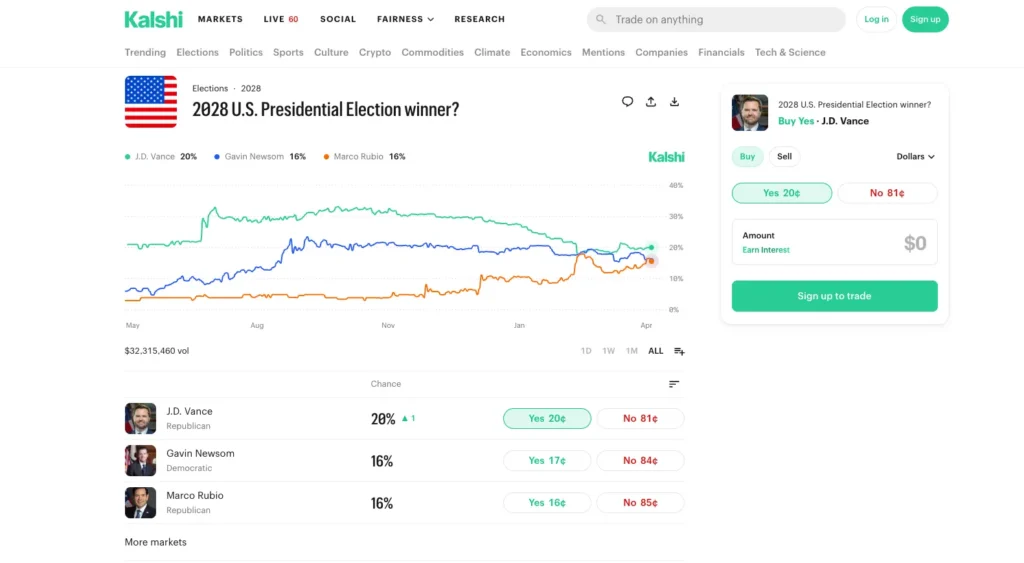
If a contract is trading at 30% YES on Kalshi and you think the real probability is 50%, you have an edge. The contract is underpriced by 20 points. That’s a good trade regardless of whether it resolves YES or NO, because over many bets with that kind of edge, you’ll come out ahead.
If a contract is priced at 30%, and you also think it has about a 30% chance of happening? That’s a fair price. No edge. The 3.3x payout sounds nice, but you’re expected to lose 70% of the time. The math cancels out.
And if a Polymarket contract is at 30% and you think the real probability is 15%? That’s a bad trade even though it pays 3.3x. You’re overpaying for an unlikely outcome.
The payout multiple doesn’t tell you if a pick is good; the gap between the market’s price and your honest assessment does.
Check out this Polymarket referral code guide for full terms and claiming instructions.
How to Think About Sizing a Prediction Market Trade
Once you’ve decided a contract is mispriced, the next question is: how much should you trade?
Here are three approaches, from the simplest to the most disciplined.
1. The Flat Amount Method (Beginner-Friendly)
Pick a dollar amount you’re comfortable losing on any single market: $10. $50. $100. Whatever it is, use that same amount every time. Don’t scale up because you feel confident. Don’t go bigger because the payout is juicy; the idea is to protect you from yourself.
The advantage is simple. No math. No emotional decisions. The disadvantage: you’re treating a 20-point edge the same as a 2-point edge.
2. The Percentage Method (intermediate)
Risk a fixed percentage of your total account on each bet. 2-5% is a common range. If you have $1,000 in your Kalshi account, that’s $20-$50 per market.
Why percentages work better than flat amounts: your bet sizes automatically shrink when you’re losing (protecting your remaining capital) and grow when you’re winning (pressing your advantage). You can’t blow up your account with 2% bets — it’s mathematically impossible in a single trade.
3. The Kelly Criterion (Advanced)
Kelly is a formula that tells you the optimal bet size based on your edge and the payout odds. It’s used by professional bettors, poker players, and some hedge funds.
The simplified version: Kelly % = Edge / Odds
Where:
- Edge = your estimated probability minus the market price
- Odds = the payout multiple minus 1
Example: a contract is at 30% (cost: 30¢, pays $1). You think the real probability is 45%.
- Edge = 0.45 – 0.30 = 0.15
- Odds = (1/0.30) – 1 = 2.33
- Kelly % = 0.15 / 2.33 = 6.4% of your bankroll
If you have $1,000, Kelly says bet $64.
Most professional traders use “fractional Kelly” — half Kelly or quarter Kelly — because the full Kelly amount assumes your probability estimate is exactly right, which it never is. Half Kelly gives you most of the growth with much less variance.
Refer to this Kalshi invite code guide for full terms and claiming instructions.
The Mistakes that Blow Up Accounts
Mistake 1: Sizing Based on Conviction Instead of Edge.
“I feel really strongly about this” is not a sizing strategy. You can feel strongly about a 50/50 coin flip. Conviction without a specific probability estimate is just emotion wearing a trading costume.
Before you size a bet, write down your probability estimate. Actually write it down. “I think this is 55% likely.” Then compare it to the market price. If you can’t articulate a specific number, you don’t have an edge — you have a hunch.
Mistake 2: Treating Cheap Contracts like Lottery Tickets.
A contract at 5% pays 19x. That’s tempting. But if you’re buying it because “anything could happen,” you’re paying 5 cents for something the market has thoroughly analyzed and priced at 5% for a reason. Buying 5-cent contracts for fun with small amounts is fine. Putting real money there because the payout is exciting is how accounts go to zero.
Mistake 3: Going All-In on a Single Market.
Even if you have a genuine 20-point edge, the most likely outcome on any single prediction market is still uncertain. That’s the nature of probabilities. A 60% contract still resolves NO four times out of 10. If you put your entire account on one trade, a single wrong resolution wipes you out, regardless of whether the pick was mathematically correct.
Diversification across multiple markets with smaller positions is almost always better than concentration in one market with a large position.
Mistake 4: Not Accounting for Opportunity Cost.
Prediction markets lock up your capital until the contract resolves. If you buy a “Will X happen by December 31?” contract in April, your money is tied up for eight months. Even if you’re right, that capital could have been deployed on shorter-duration markets with faster resolution.
Think about when the contract resolves, not just whether you’ll be right. A 30% edge on a contract that resolves in three days is worth more than a 30% edge on a contract that resolves in six months.
A Real-Life Example
Let’s use the Iran peace deal market:
The contract: “US x Iran permanent peace deal by April 30?” Trading at 38% YES.
You look at the news. The ceasefire is holding. Pakistan is mediating. The White House says they “feel good about a deal.” The top Polymarket traders are unanimously on YES. You think the real probability is closer to 50%.
Your edge: 50% – 38% = 12 points. The payout: buy at 38¢, get $1 if YES. That’s a 2.63x return.
Using half Kelly: Edge (0.12) / Odds (1.63) = 7.4%. Half that = 3.7% of your bankroll.
On a $1,000 account: $37.
That’s it. Not $500. Not $200. Thirty-seven dollars. On a market where the top traders are unanimously positioned, and you think you have a 12-point edge.
That number feels small. It should. Disciplined bet sizing always feels small in the moment and feels exactly right over 50 trades.
Don’t want to do the math yourself? Use the free Kelly Criterion calculator at flowframe.xyz/kelly — plug in the market price, your estimated probability, and your bankroll. It does the rest.
Final Thoughts on How to Size a Prediction Market Trade
If you remember nothing else from this piece, remember this: The payout tells you what you win. The edge tells you if you should trade. The sizing tells you how much.
Get all three right, and you can survive being wrong on any individual trade. Get any one of them wrong, and a single bad outcome can set you back months.