
Prediction Markets vs. Sports Betting: The Key Differences Explained
The prediction markets vs. sports betting argument has never been more intertwined in the public conversation.
The 2024 US presidential election introduced millions of Americans to platforms like Kalshi and Polymarket for the first time, as contract prices tracked the race more accurately than most traditional polls. The 2026 Super Bowl drove billions of dollars in prediction market trading volume alongside the usual sportsbook handle.
Suddenly, two industries that once operated in separate worlds are competing for the same audience and the distinction between them is genuinely confusing to most people.
Prediction Markets vs. Sports Betting At-a-Glance
On the surface, the similarities are real. Both involve putting money on uncertain future outcomes. Both let you profit if you’re right. Both carry meaningful financial risk if you’re wrong. Many of the events you can trade on prediction markets, such as who wins a championship, and which team covers the spread, are the same events you’d find at a sportsbook.
But beneath that surface, the two models are built on fundamentally different foundations. Sports betting is a centuries-old industry centered on bookmakers who set the odds, take your bet, and profit from the margin built into every wager. Prediction markets are closer to financial exchanges: you’re not betting against a house, you’re trading contracts with other participants, and the price is set by collective market activity rather than by an operator protecting its bottom line.
Those structural differences of prediction markets vs. sports betting ripple outward into how prices are set, what you can bet on, whether winning players get banned, how the activity is regulated, and ultimately who each product is designed to serve.
This guide breaks down every meaningful distinction between the two, so you can understand which one fits your goals, your risk tolerance, and where you live.
TLDR: Key Differences Between Sports Betting & Prediction Markets
In sports betting, you wager against a bookmaker who sets the odds and keeps a built-in margin. In a prediction market, you trade contracts with other users, and the price is set by supply and demand, much like a stock exchange.
Prediction markets tend to be more information-efficient and have no inherent house edge, but they also cover a much broader range of events beyond sports.
Prediction Markets vs. Sports Betting
| Prediction Markets | Sports Betting |
|---|---|
| Exchange model allows you trade with other users. | Centralized model. Users bet against the bookmaker. |
| Prices set by supply and demand. | Odds set by the operator with a built-in margin. |
| Enter and exit positions before resolution. | Fixed position once bet is placed (mostly). |
| Contracts price as implied probabilities (0–$1). | Odds expressed as American, decimal, or fractional. |
| Platform earns fees on trades, not from losses. | Bookmaker profits from the vig on every bet. |
How Each Model Works
Sports betting is centralized. You place a wager against a bookmaker — DraftKings, FanDuel, bet365, and their peers — and if your prediction is correct, the bookmaker pays you according to the odds they set. The bookmaker is the counterparty to every bet. They use statistical models, risk management, and real-time adjustment to set lines that balance their book and ensure a profit over time.
The simplicity is part of the appeal: pick a team or a player prop, agree to odds, and wait. Most sportsbooks do not allow you to exit a position before an event ends, except via a “cash-out” feature that typically comes at unfavorable terms.
Prediction markets are exchange-based and peer-to-peer. Rather than betting against a house, you buy and sell outcome contracts with other users. Each contract trades between $0 and $1 (or equivalent). If the event you backed occurs, your contract pays out $1. If it doesn’t, it goes to zero. The price of the contract at any moment represents the market’s collective probability estimate for that outcome.
The leading regulated platforms include Kalshi and Robinhood’s event contracts in the US, and the crypto-native Polymarket globally. Major traditional financial brokerages like Robinhood have entered the space, with over 500 million presidential election contracts traded on Robinhood during the 2024 US election cycle alone.
How Contract Prices and Odds are Set
This is the most consequential difference of prediction markets vs. sports betting, and it shapes everything downstream.
In sports betting, a bookmaker’s pricing team sets the opening line based on internal models, then adjusts it as money flows in, primarily to balance exposure rather than to discover the “true” probability of an outcome. The odds contain a built-in bookmaker margin. A market priced at -110 on both sides of a spread, for example, implies the bookmaker keeps roughly 4.5% of every dollar wagered regardless of the outcome. The stated odds, therefore, are not a pure probability estimate; they are probability plus margin.
In prediction markets, prices emerge from trading. When a contract for “Team A wins” is priced at $0.62, that reflects what the entire pool of active traders collectively believes: a 62% chance. If you think Team A is actually a 75% shot, you buy the contract at $0.62, and if enough people agree, the price rises. Prices update continuously as new information enters the market, whether that’s an injury announcement, a weather report, or a late line movement elsewhere.
Because prediction market prices are driven by information aggregation rather than bookmaker risk management, they tend to function as more accurate probability estimates. Research consistently finds that well-traded prediction markets outperform traditional polls and expert forecasts, particularly for political and economic events. During the 2024 US election, prediction markets tracked a more accurate outcome probability than most major polls through the final weeks of the campaign.
Use our guide on how to size a prediction market trade for more pricing insights and strategies.
House Edge and Trading Fees
The structural difference in how money is made on prediction markets vs. sports betting is stark, and it has real implications for long-term returns.
In sports betting, the house edge is embedded invisibly in every set of odds. A standard -110/-110 spread bet carries roughly a 4.5% vig. Parlay bets can carry implied edges of 15-20%. The bettor is paying this margin on every single wager, whether they win or lose. Over time, this structural disadvantage compounds: even skilled, sharp bettors face a built-in ceiling. Notably, sportsbooks actively limit or ban accounts that win consistently, their business model depends on recreational bettors losing.
“Sportsbooks are the house. Prediction markets make the users the house.” — Tarek Mansour, CEO of Kalshi
Prediction markets have no house edge in the traditional sense. The platform collects explicit transaction fees, not a spread embedded in the pricing. Fee structures vary by platform: Kalshi charges approximately 7% on profits, PredictIt historically charged 10% on profits plus a 5% withdrawal fee, while some platforms like Polymarket have charged 0% on standard markets. Because you know exactly what you’re paying and the price is set by other traders rather than by the house, there is no structural disadvantage to the participant. Skilled forecasters are not banned; their activity is welcomed, as it improves market efficiency.
Analysis suggests that the absence of a house margin makes prediction market participants significantly more likely to turn a net profit over time compared to traditional sportsbook bettors, all else being equal. The key caveat: “all else being equal” is doing a lot of work here. Prediction markets require a different skill set, closer to financial trading than to sports analysis, and liquidity can be thin outside major events.
What You Can Bet or Trade On
Sports betting is almost entirely focused on athletic competitions. A major US sportsbook will offer thousands of markets daily, game lines, player props, in-game live betting, but the events are sports. Political betting, for instance, is not legally available at US sportsbooks.
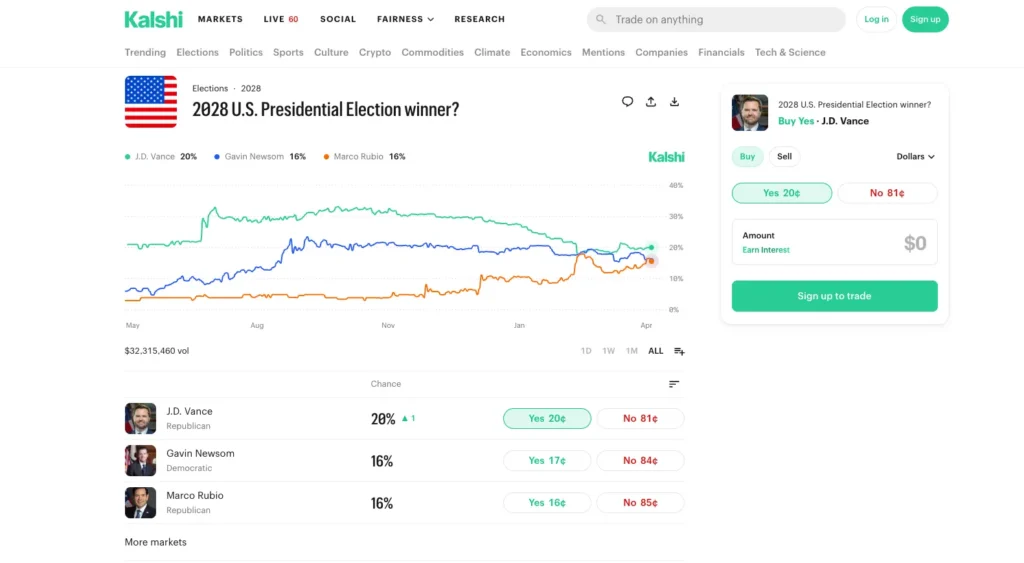
Prediction markets cover a dramatically wider surface area. In addition to sports, platforms like Kalshi and Polymarket routinely offer contracts on US and international elections and political outcomes, Federal Reserve interest rate decisions, economic indicators (inflation, unemployment, GDP), corporate events (earnings, CEO departures, mergers), technology milestones (AI benchmarks, product launches), entertainment and pop culture events (Oscars, award shows), and geopolitical events and international developments.
This breadth is one reason prediction markets attract a different audience, analysts, researchers, policy professionals, and financial traders, alongside the sports-focused crowd that drives sportsbook volume. A macroeconomist with strong views on inflation policy has no natural home at a sportsbook, but is a natural participant in a prediction market.
Refer to this Kalshi promo code guide for full terms and claiming instructions.
Trading Flexibility and Liquidity
Prediction markets function like exchanges, which means you can enter and exit positions at any time before the market resolves. If you buy a contract at $0.40 and the price moves to $0.70 because sentiment has shifted, you can sell and lock in profit, even if the underlying event hasn’t happened yet. This creates strategic possibilities unavailable in traditional betting: arbitrage across platforms, hedging positions, momentum trading, and portfolio-style diversification. Seriously, prediction market strategy is something to lean on.
Sports betting is far simpler and more rigid. You place a bet, and you wait for the outcome. Early cash-out features exist at many sportsbooks, but they are set by the bookmaker and typically offered at terms that favor the house. There is no secondary market where you negotiate an exit price with other bettors.
The trading flexibility of prediction markets only works in practice when there is sufficient liquidity, enough buyers and sellers to execute trades at reasonable prices. During major events (a presidential election, the Super Bowl), prediction market liquidity can be deep. For smaller or more obscure markets, bid-ask spreads can be wide and positions can be difficult to exit at fair value. This is a meaningful constraint that doesn’t affect sportsbooks, where the bookmaker will always give you a quote.
Regulation and Legality
Regulation is perhaps the most complex and actively evolving dimension of prediction markets vs. sports betting, particularly in the United States.
Sports betting in the US is regulated at the state level, following the 2018 Supreme Court decision in Murphy v. NCAA that struck down the federal prohibition. As of 2026, online sports betting is legal in 39 states and Washington D.C. Each state licenses operators individually, and sportsbooks like DraftKings and FanDuel must obtain approval in each state where they operate. Sports betting is universally classified as gambling by the states that regulate it.
Prediction markets occupy a different legal category. In the US, regulated prediction markets operate under federal oversight from the Commodity Futures Trading Commission (CFTC), which classifies outcome contracts as “event contracts” or derivatives financial instruments, not gambling products. Companies like Kalshi are registered as Futures Commission Merchants (FCMs), subject to CFTC rules rather than state gaming commissions.
This federal framework means prediction market availability can extend beyond states where sports betting is legal. However, the regulatory landscape is actively contested. Several states, including Illinois, Maryland, Nevada, New Jersey, and Ohio, have issued cease-and-desist letters to prediction market operators, arguing that sports-related contracts fall under their state gambling authority. Kalshi has filed suit against Nevada and New Jersey regulators, arguing federal law preempts state jurisdiction. The dispute will likely require federal court resolution, and potentially Supreme Court review.
Polymarket, the crypto-native platform, operates outside US jurisdiction and is only available to American users on mobile after joining a waitlist, a reminder that the global regulatory picture is even more varied.
Side-by-Side Comparison
| Prediction Markets | Sports Betting | |
|---|---|---|
| Structure | Prediction markets use a peer-to-peer exchange where you trade with other users. | Sports betting is centralized, you bet against the bookmaker. |
| Price Setting | Prediction market prices emerge from supply and demand, reflecting crowd-driven probability. | Sportsbook odds are set by the bookmaker with an embedded margin. |
| House Edge | Prediction markets have none, they charge explicit transaction fees only. | Sports betting carries a built-in vig of typically 4-10%. |
| Event Coverage | Prediction markets cover sports, politics, economics, entertainment, and more. | Sports betting covers sports and sporting events only. |
| Exit Flexibility | On prediction markets you can sell your position any time before resolution. | Sports betting positions are fixed, with limited cash-out at the bookmaker’s terms. |
| US Regulation | Prediction markets operate under federal CFTC oversight and are available in most states. | Sports betting is regulated state-by-state and legal in 39 states plus D.C. |
| Pricing Transparency | Prediction markets charge explicit fees and prices reflect true probability. | Sportsbooks hide their margin inside the odds. |
| Ease of Use | Prediction markets are more complex and require understanding trading mechanics. | Sports betting is simple, pick, stake, wait. |
| Liquidity | Prediction markets are deep on major events but thin on smaller ones. Sportsbooks offer deep liquidity across most markets. | Sportsbooks offer deep liquidity across most markets. |
Which Is Right for You?
There is no universal answer when analyzing prediction markets vs. sports betting. The right choice depends on what you’re trying to accomplish, which kinds of events you follow, and how you approach risk.
Prediction markets suit you if you want to bet on politics, economics, or non-sports events; if you think like a trader and want to exit positions early; if you prefer transparent fees over hidden margins; if you’re a consistent winner and don’t want to be limited; if you’re interested in information markets and probability; or if you live in a state where sports betting isn’t legal.
Sports betting suits you if you want deep liquidity on any game or sport at any time; if you prefer simplicity, pick, stake, and wait; if you’re a recreational bettor with no need to trade out; if you want access to thousands of markets and live betting; if you’re comfortable with the traditional gambling framework; or if you want promotions, bonuses, and new-user offers.
For many people, both have a role. A sports fan might use a sportsbook for game-day entertainment while also holding positions on a prediction market during an election or Fed meeting. The two products serve overlapping but distinct purposes, and the growth of prediction markets into the mainstream, driven by the 2024 election and the 2026 Super Bowl, suggests that millions of people are finding room for both.
Get more resources on responsible trading on prediction markets here.
Prediction Markets vs. Sports Betting FAQs
Are prediction markets legal in the United States?
Yes, regulated prediction markets are legal in the US under federal CFTC oversight. Platforms like Kalshi operate as licensed Futures Commission Merchants. However, some states have challenged their jurisdiction over sports-related event contracts, and this legal battle is ongoing.
Can you make money with prediction markets?
Yes, skilled forecasters can profit on prediction markets. Because there is no built-in house edge, well-calibrated traders who consistently identify mispriced probabilities can generate returns over time. Unlike sportsbooks, prediction markets do not ban or limit winning participants. That said, trading carries real risk, and there is no guarantee of profit.
What’s the difference between prediction markets and betting exchanges?
They share the peer-to-peer structure: both let users trade with each other rather than against a house. The main differences are event coverage (prediction markets include non-sports events), regulatory classification (CFTC vs. state gambling), and how positions are structured. Betfair, the largest betting exchange, operates more like a traditional sports betting market but with peer-to-peer pricing.
What is Polymarket and is it available in the US?
Polymarket is a crypto-native prediction market operating on the Polygon blockchain. It does not require a traditional account and has historically attracted massive trading volume, including $2.7 billion on the 2024 US presidential election. However, Polymarket is only available in the US via mobile app and you have to join a waitlist before trading.
How are prediction market contracts priced?
Contracts trade between $0.00 and $1.00. A contract priced at $0.65 implies the market currently estimates a 65% probability of that outcome occurring. If the event happens, the contract pays $1.00. If not, it goes to $0.00. Prices move continuously based on trading activity and new information.
Can sportsbooks ban winning bettors?
Yes. Traditional sportsbooks can and do limit or ban accounts that win consistently, as sharp bettors reduce the bookmaker’s profit margin. This is a fundamental feature of the bookmaker model. Prediction markets, by contrast, have no incentive to limit winners, consistent forecasters improve the quality of market prices, which benefits the platform.
Which is better for sports: prediction markets or sportsbooks?
For casual fans, sportsbooks offer greater simplicity and event depth. For analytical bettors, prediction markets offer better terms (no house edge, no banning) but potentially thinner liquidity on specific games. Major sports events, Super Bowl, playoff series, championship matches, tend to have strong prediction market liquidity, making them viable alternatives for significant bets on high-profile outcomes.