
Prediction Markets Face Public Scrutiny Over Insider Trading Risks
A new survey finds that many people are worried about websites that let users bet on events like elections and military actions. There is also little trust that these prediction markets can stop insider trading or prevent bad people from taking advantage.
The Scripps News/Talker Research survey was conducted April 14–22, 2026, and included 2,000 U.S. registered voters, who were surveyed online. That survey has a margin of error of ±2.2% at a 95% confidence level.
The survey indicates that most people are unfamiliar with prediction markets and have serious doubts and ethical concerns about them. In fact, just last week, someone manipulated temperature readings in France to win two big sums of money.
Key Findings of the Survey
Some of the key findings from the poll include:
Limited familiarity and use: 57% of respondents said they were “not very” or “not at all” familiar with prediction markets. Only 19% had personally traded on these platforms, which involve yes/no contracts on future events. Another 16% knew someone who used platforms like Polymarket or Kalshi. Younger people seem to use these markets more, with 31-37% of millennials participating.

Concerns about betting topics: More than 70% of Americans said they were “very” or “somewhat” concerned about platforms allowing bets on big events like:
- Election results.
- Military actions.
By comparison, only 49% were as concerned about sports betting on these platforms. Meanwhile, bets on whether public officials would resign had 61% concerned.
Doubts about fairness: 63% of people had little to no faith in prediction markets being able to stop insider trading. Also, 73% were worried about people with insider knowledge (like government or military officials) manipulating the markets to gain unfair profits.
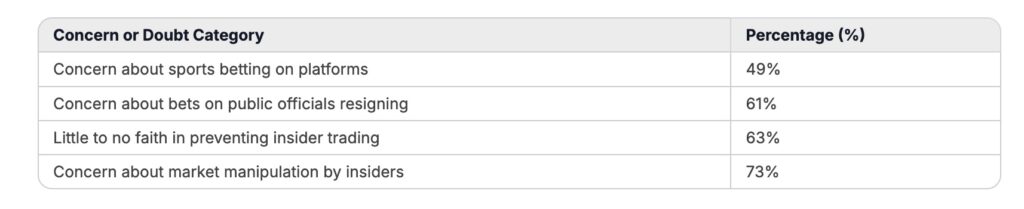
Overall, the survey shows that while the public isn’t very familiar with these markets, it feels uneasy about gambling on elections, wars, or official resignations, and doubts the safeguards against misuse.
What This May Mean for Prediction Markets
Prediction markets are platforms where people trade contracts that pay out based on real-world events (e.g., “Will Candidate X win?”, “Will Event Y happen by Date Z?”, and even the second coming of Jesus Christ).
The best example is sports. The industry has been taken over by prediction markets recently.
Supporters say these markets can gather information quickly and sometimes predict outcomes better than regular polls by having people put money on the line. Platforms like Polymarket and Kalshi became well-known during the 2024 U.S. Presidential Election and have expanded to entertainment, weather, and other areas.
Trading on these markets has grown fast, with nearly $64 billion spent last year, leading to more regulatory attention. Lawmakers are crafting bipartisan bills to address sports betting and insider trading risks on these platforms.
Critics and the public (according to this survey) worry about:
- Manipulation, especially with insider information about politics, elections, or military actions.
- Moral/ethical issues with betting on potentially tragic or important outcomes (like conflicts).
- Regulatory issues compared to traditional gambling or stock markets.
Supporters argue that well-designed markets with limits, reporting rules, and restrictions (like barring military personnel from betting on operations) can address these risks.
They claim these markets often represent public opinion better than experts alone. Still, the survey indicates most Americans are not convinced by these arguments yet. The survey shows growing interest in prediction markets as their use rises, even though awareness is low and trust in their fairness is lacking.