
Robinhood Draws Line on Prediction Markets
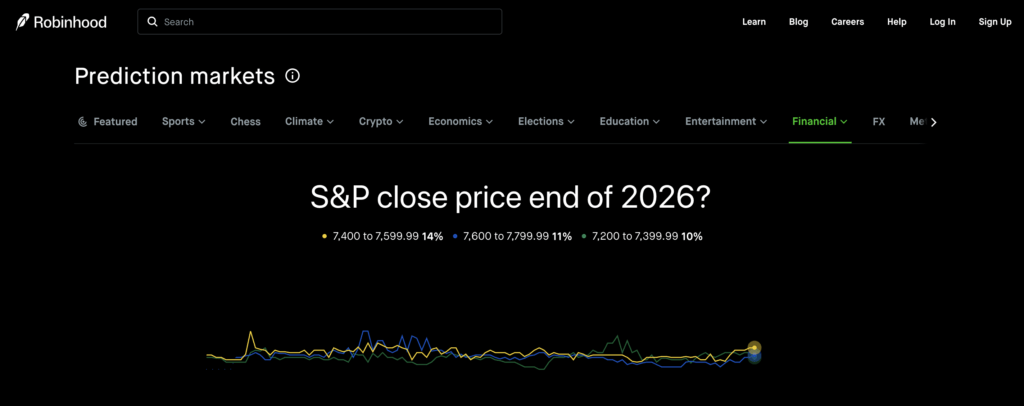
Robinhood Markets (NASDAQ: HOOD) is taking a curated approach to prediction markets, deliberately choosing not to offer certain event contracts to its customers amid growing concern about insider trading and market manipulation in the space.
Jordan Sinclair, president of Robinhood UK, told the Financial Times that the brokerage is “very focused on market abuse and insider trading.”
As a result, the menu of yes/no contracts available on Robinhood’s platform will be narrower than what competitors offer.
“We don’t necessarily offer all prediction markets or all event contracts,” he said. “There are some we’ve chosen that aren’t right for our customers.”
The move is entirely self-imposed.
Unlike traditional financial markets, prediction markets aren’t currently subject to federal or state insider trading laws, though lawmakers are pushing to change that.
Mention Markets Muted
Mention markets are the most notable contracts that Robinhood is avoiding. Those are predictions on whether specific words or phrases will be “mentioned” during a public event, an earnings call, a White House press briefing, or a political speech. Because the people writing or delivering those remarks know the content in advance, mention markets are considered especially vulnerable to insider trading.
Sinclair confirmed Robinhood passed on these contracts “for exactly some of those concerns.“
The risk is not theoretical. Earlier this year, Kalshi, Robinhood’s primary prediction market partner, suspended and fined a former editor for YouTube creator MrBeast, after he used advance knowledge of video content to profit from mention market trades.
Last year, Coinbase CEO Brian Armstrong drew criticism for jokingly rattling off buzzword phrases during a company earnings call, a stunt widely seen as a nod to mention market traders.
Robinhood Stakes Reputation on Restrictions
Robinhood has strong financial incentives to keep its prediction market offerings clean. CEO Vlad Tenev has called it the company’s fastest-growing business ever, with more than 12 billion contracts traded in 2025. The company projects the segment will eventually generate $300 million in annual revenue, and Tenev has described the moment as the beginning of a “prediction market supercycle” that could drive trillions in trading volume over time.
The brokerage has deliberately aligned itself with regulated partners. It currently offers prediction markets through Kalshi and ForecastEx, both of which operate as CFTC-registered exchanges with strict identity verification requirements. It has no partnership with Polymarket, Kalshi’s biggest rival, which allows users to participate via cryptocurrency wallets with minimal know-your-customer protocols.
For a publicly traded company with a largely retail customer base, the reputational calculus is straightforward. Robinhood has been down the road of trading controversy before. During the meme stock frenzy of 2021, the platform was widely criticized for temporarily halting trading in GameStop and AMC Entertainment at the height of the retail investor uprising, a decision that drew congressional hearings and a wave of lawsuits.
The company clearly has no appetite for that kind of backlash again, especially in a business line it is counting on for long-term growth.
Broader Scrutiny Growing for Prediction Markets
Robinhood’s voluntary limits arrive as the prediction market industry faces pressure from multiple directions. Congress is pushing the White House for details on suspicious trades tied to Iran war contracts on Polymarket. Several newly created accounts were found to have made unusually large, well-timed bets ahead of ceasefire announcements, drawing comparisons to classic insider trading scenarios.
Bipartisan senators have introduced legislation that would strip the CFTC of authority over sports and casino-style event contracts, handing control back to states. Israeli authorities have already charged two individuals with using classified military intelligence to place bets on Polymarket. And in the US, a Nobel Peace Prize announcement triggered a leak investigation after trading volumes spiked suspiciously ahead of the news.
By drawing its own lines now, before regulators force the issue, Robinhood is betting that responsible curation today is worth more than unrestricted access tomorrow.